
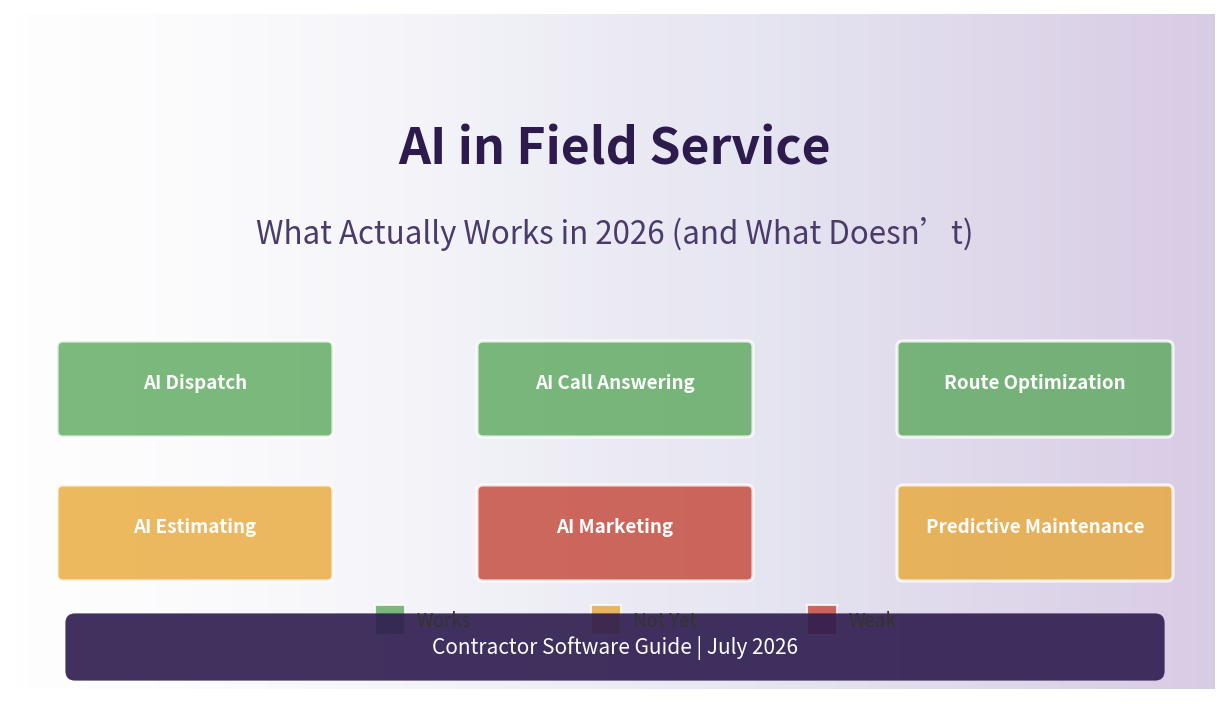
The AI Hype vs. The Field Reality
Every field service platform added an "AI" feature in 2025–2026. ServiceTitan launched Titan Intelligence. Jobber shipped Copilot. Housecall Pro rolled out CSR AI and Marketing AI. Deelo and FieldCamp built autonomous dispatchers. The marketing copy is bold. The reality is more mixed.
We tested or interviewed contractors using these tools. Here is what actually saves time, what is promising but unfinished, and what is just a chatbot with a new name.
What Actually Works: 3 Features Worth Paying For
1. AI-Powered Dispatch (ServiceTitan Dispatch Pro, FieldCamp AI Dispatcher)
What it does: Instead of a human dispatcher staring at a whiteboard or drag-and-drop calendar, the AI reads incoming jobs, technician locations, skill sets, and appointment windows, then assigns the optimal tech.
Why it works: ServiceTitan’s Dispatch Pro optimizes for revenue, not just efficiency. It might assign a farther-away tech to a high-value replacement job if that tech has a better close rate. FieldCamp’s AI dispatcher builds 30 days of schedule in seconds and treats EPA certifications as hard constraints.
Real impact: Contractors using Dispatch Pro report 15–25% improvement in first-time fix rates and 10% higher average ticket size. The catch: it only makes sense at 15+ trucks. At 3 trucks, the optimization gain is smaller than the setup overhead.
2. AI Call Answering (Jobber AI Receptionist, ServiceTitan AI Voice Agents)
What it does: An AI voice agent answers your business phone, checks your calendar for availability, and books the job directly into the dispatch board. No human CSR needed for routine inbound calls.
Why it works: HVAC and plumbing shops lose 30–40% of after-hours leads to voicemail. An AI receptionist that answers at 8 PM and books the 9 AM slot is direct revenue recovery. Jobber’s AI Receptionist ($99/mo add-on) is one of the more affordable options.
Real impact: Contractors who deploy this typically see 10–20% more booked jobs within the first month, especially in seasonal peak (August AC failures, January pipe bursts). The limitation: it handles inbound only. It will not make outbound follow-up calls or handle messages from Angi or Thumbtack leads.
3. Route Optimization (Smarter Routing, Drive-Time-Aware Scheduling)
What it does: AI considers traffic patterns, appointment windows, technician skills, and job priority to build the most efficient daily route. Technicians spend less time driving and more time billing.
Why it works: The math is straightforward. ACCA data shows residential HVAC techs lose 90–120 minutes per day to inefficient routing. At $120/hour billable rate, that is $180–$240 per tech per day in lost revenue. Route optimization typically recovers 30–50% of that.
Real impact: A 5-tech shop recovering 45 minutes per tech per day gains 3.75 hours of billable time daily. At $120/hour, that is $450/day or ~$112,500/year. The ROI is immediate and measurable.
What Is Promising But Not There Yet
AI Estimating and Price Insights
ServiceTitan’s Price Insights shows how your pricing compares to regional averages. It is useful for competitive positioning but not for building estimates from scratch. Jobber and Housecall Pro do not have AI estimating yet. The gap is real: creating a flat-rate replacement quote from a photo of a rusted condenser is still not reliable.
AI Marketing Content
Housecall Pro’s Marketing AI generates email and postcard copy. It is competent for generic seasonal campaigns ("Spring tune-up special!") but struggles with trade-specific nuance. You will still edit every piece before sending. The time savings is marginal—maybe 10 minutes per campaign.
Predictive Maintenance via IoT Sensors
The idea is compelling: sensors on HVAC units predict failures before they happen, triggering automatic service calls. The reality is that sensor deployment, connectivity, and data quality are expensive and inconsistent. For 2026, this is viable for large commercial contracts (chiller plants, data centers) but not for residential HVAC.
What Is Just a Chatbot
Be skeptical of any AI feature described as "your AI assistant" or "AI sidekick" that mostly answers questions about how to use the software. ServiceTitan’s Atlas AI and Jobber’s Copilot both fall into this category for some tasks. They are helpful for new users learning the interface, but they do not replace a trained admin or reduce your headcount.
The test is simple: Does this feature directly book a job, dispatch a tech, or collect a payment? If the answer is no, it is likely a training tool, not an operational tool.
What This Means for Small Contractors
AI is not a magic upgrade. It is a layer of automation on top of processes that already work. If your current dispatch board is a whiteboard that works fine, AI dispatch will not fix a broken workflow—it will accelerate the chaos. If your team already books 80% of after-hours calls, an AI receptionist is marginal improvement, not transformation.
Start with one high-leverage area:
- If you have 15+ trucks and a dedicated dispatcher → Test AI dispatch.
- If you lose after-hours leads to voicemail → Test AI call answering.
- If your techs drive 2+ hours between jobs → Test route optimization.
Measure before and after. AI vendors love to promise ROI but rarely guarantee it. The contractors seeing real gains are the ones who picked one pain point, baseline the metrics, deployed the tool, and measured the difference.
Bottom Line
AI in field service is moving from "interesting demo" to "operational tool" in 2026, but only in specific areas. Dispatch, call answering, and routing are mature enough to justify the investment. Estimating, marketing content, and predictive maintenance are still works in progress. Buy what solves a real problem today, not what might be useful in 2027.
Ready to turn the advice into a setup plan?
Head back to the homepage for trade guides and comparisons, or take the quiz to shape a practical software stack for your team.
Need help applying this to your business?
Use the article as a starting point, then share your trade, team size, and current tools so we can help shape a practical setup path.
Get a Free Software Setup PlanRelated articles
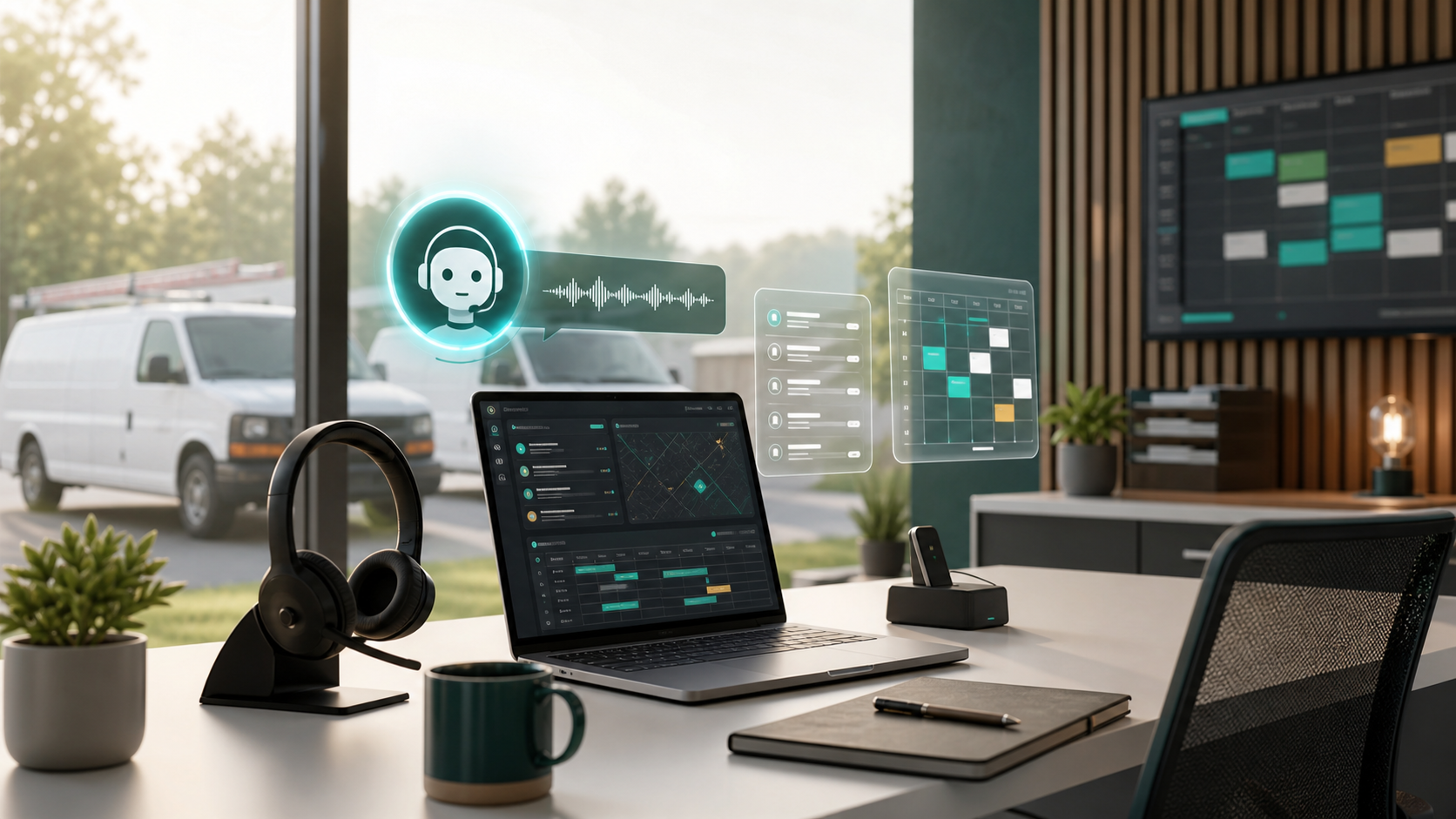
AI Receptionist Software for Contractors: What to Automate First in 2026
AI receptionist tools are moving from generic chatbots into call intake, booking, and dispatch workflows. Here is what contractors should automate first, what to keep human, and how to choose software that fits the field.
Field Service Software Pricing: 2026 Complete Cost Guide (37 Tools Ranked)
The only independent pricing guide covering 37 field service tools. See real monthly costs, hidden fees, and contract terms that vendors don't publish on their pricing pages.
How to Connect QuickBooks to Field Service Software
A practical guide for contractors who need field service software, invoices, payments, booking, and customer records to work cleanly with QuickBooks.